NOTE: Names and private details have been changed to protect the privacy of those involved.
This weekend, I saw a post on Facebook. A friend was looking for help for someone else dealing with what was described as “diagnosis here.” Of course, my first instinct was to help. Then came the questions.
How old is this person? Male, female or non-binary? Is this self-diagnosis or from a medical doctor? If so, what is it? Are they ambulatory? Can they leave the house? Would an online service be more appropriate? Are they looking for someone who could come to them?
There simply wasn’t enough information for me to say, “You should call this person.” And maybe that was a good thing.
Instead, I sent a Holistix Online directory search to the friend who had made the post. That gave the person looking for help access to possibilities they could explore for themselves. And it got me thinking about how referrals really happen.
Referrals don’t always begin with the client
When we talk about getting referrals, we tend to picture one person saying to another, “You should call Susan. She’s terrific.” Sometimes that’s exactly what happens. But sometimes the person who needs something isn’t the one doing the searching.
A spouse searches. A parent asks around. A coworker remembers a conversation. A friend posts something on Facebook.
The person looking on someone else’s behalf may not know all the details, and they probably shouldn’t be sharing all the details, especially not on a public forum. Health, wellness and emotional concerns can be deeply personal. Even when privacy laws don’t apply to a particular conversation or organization, respecting someone’s privacy still matters.
That can make the referral road a little foggy. But it doesn’t have to stop the referral.
You don’t always need to know exactly what someone needs
One of the advantages of referring someone to a resource rather than a specific provider is that you don’t have to diagnose the problem yourself. In fact, you shouldn’t. You can simply help someone take the next step.
That’s one of the reasons we created the Holistix Online directory. Someone can explore different professionals, services and approaches without having to explain their entire situation to everyone along the way.
They can also look through events, including online opportunities, that may introduce them to new information, approaches or professionals. The person doing the referring doesn’t have to have all the answers. Sometimes the most helpful answer is, “Here’s a good place to start looking. There are plenty of possibilities you can explore.”
Your next referral may begin with someone you’ve never met
For holistic professionals, there’s a business lesson hiding in this story. When you think about attracting new clients, patients or customers, you probably think about reaching the people who need what you offer.
But those aren’t the only people who need to know you exist. Their friends do. Their families do. Their coworkers do. Other professionals do. And sometimes complete strangers who happen to see a Facebook post do.
That’s part of what virtual visibility does. The person who sees your name today may never become your client. They may, however, remember you three months from now when someone says: “Do you know anybody who…?”
Suddenly, they’re part of your referral network, even though neither of you knows it.
Referrals can travel with very little information
There’s another wrinkle. The more people involved in a referral, the less information may make it all the way through.
Sometimes that’s frustrating from a marketing perspective. Where did this person hear about me? Who referred them? What did they tell them? Why did they choose me?
But from the perspective of the person seeking help, limited information can be entirely appropriate. They may not want their health history, emotional concerns or personal circumstances traveling alongside their name. They just want some ways to fix what’s going on.
So perhaps we shouldn’t expect every referral to arrive neatly packaged with its complete origin story attached. The important thing is that the person finds a useful next step. Maybe that next step is you, your product, your service.
That's where the roundabout begins
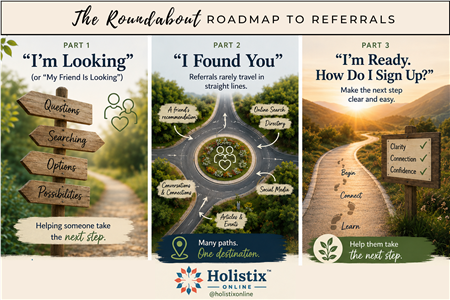
Think about what happened in this case. Someone needed help. A friend posted on Facebook. I saw the post. I responded with a Holistix Online directory search. The friend could pass that resource along. The person could explore the professionals listed there.
And from that point? I have no idea. They might contact someone today. They might attend an event. They might bookmark three websites and come back next month. They might show the information to someone else. They might find exactly the person they need.
And that’s when the referral road gets really interesting. Because if they eventually contact one of those professionals and say, “I found you…” Where did that referral actually come from?
We’ll follow that road in Part 2.
Camille Leon is the Founder and CVO (Chief Visionary Officer) of Holistix Online. She's also an abstract artist and the author of Fresh Starts / Transformation in Action. Whether you're looking for or offering a holistic approach to health, life, or business, Camille's purpose in life is to get you connected.
Support Holistix Online