
There's a shift that happens in late summer. The light changes. The air loses that thick, heavy edge. School supplies show up in stores. Pumpkin spice starts creeping onto menus.
And somewhere in the back of your mind, a quiet voice says, okay, this is my moment. I want you to listen to that voice this time. Not with a crash diet or a punishing workout plan you'll abandon by week three.
I'm talking about something smaller, steadier, and — this is the part that matters most—something that actually protects your heart.
If your doctor has started using words like "let's watch this closely," you already know the stakes feel different now.
You need habits that are sustainable, science-backed, and honest about the life you're actually living, the one with the early morning meetings, the friend group that orders dessert, and the family history that keeps you up at night.
So, let's talk about what actually moves the needle. Starting with the thing most of us were never told.
We Got the Villain Wrong — It Was Sugar All Along
For decades, fat was the enemy. Low-fat everything. Fat-free labels on foods that were somehow still making us sicker.
We followed the rules. We swapped butter for margarine and whole milk for skim. We ate the cardboard rice cakes and called it discipline. And yet…heart disease in women kept climbing.
Here's what the research has been building toward for years, and what institutions like the American Heart Association and physicians like Dr. Mark Hyman have been saying with increasing conviction: Added sugar may be one of the most underestimated threats to your cardiovascular system.
A landmark study published in JAMA Internal Medicine found that people who got 17 to 21 percent of their daily calories from added sugar had a 38 percent higher risk of dying from cardiovascular disease - compared to those who kept it under 8 percent. That's not a small number.
The American Heart Association recommends no more than 25 grams of added sugar per day for women. Most of us are consuming two to three times that before lunch.
This isn't about blame. It's about information you deserved to have a long time ago. Because when you understand what's actually driving the risk, you stop fighting the wrong battle, and you start making changes that actually protect your heart.
What Exactly Is Added Sugar?
This is the question I get more than almost any other, and it's a smart one. Added sugar is the term that gets thrown around constantly, by doctors, on nutrition labels, in health articles, and almost nobody stops to actually explain it.
Here's the simple truth: Added sugar is any sugar put into a food during processing or preparation. It is NOT the natural sugar found in a whole apple, plain Greek yogurt, or a handful of blueberries. Those come packaged with fiber, vitamins, and minerals that slow how quickly sugar enters your bloodstream. Added sugar has none of that protection.
It hits your system fast, spikes your blood sugar, triggers an insulin response, and over time, that repeated cycle puts real, measurable strain on your blood vessels, your blood pressure, and your heart. And here's the part that catches most women off guard: it's rarely hiding where you expect it.
It's in the flavored coffee creamer. The "heart healthy" granola bar. The bottled salad dressing. The pasta sauce. The yogurt with the fruit on the bottom. The protein bar that feels virtuous because it has the word "protein" on the front. A single grande pumpkin spice latte can carry close to 50 grams of added sugar. That's double your entire daily recommended limit, in one cup, before you've eaten a single bite of food.
Now, don’t get me wrong here. This isn't about never enjoying something sweet again. It's about knowing where the sugar is actually coming from so you can make choices that protect your heart and still feel like yours. That's not restriction. That's information doing its job.
Why Your Body Is Responding Differently Now
If it feels like your body stopped playing by the old rules somewhere in your 40s, you're not imagining it.
As estrogen declines, your body becomes significantly more sensitive to blood sugar swings. Every spike and crash puts more strain on your blood vessels and your metabolism than it did a decade ago. That afternoon energy crash you've learned to push through? It's not a willpower problem. It's not a caffeine problem. It's a signal.
Your body is telling you that the sugar load it absorbed a few hours earlier has moved through your system, and now everything is paying the price. For women carrying cardiovascular risk factors: elevated blood pressure, high cholesterol, blood sugar numbers creeping in the wrong direction, this cycle isn't just uncomfortable. It's cumulative.
Every spike adds inflammatory pressure to a system that is already working hard. As Dr. Mark Hyman describes it, sugar triggers a cascade of inflammation that damages blood vessel walls, raises triglycerides, and drives up the very risk factors your doctor is already watching closely.
This is why the conversation about heart health in women has to include sugar. Not as a scare tactic. Not as another thing to feel guilty about. But as information that finally connects the dots between what you're eating, how you're feeling, and what's actually happening inside your cardiovascular system.
When you understand the mechanism, making small changes stops feeling like discipline. It starts feeling like self-respect.
Three Swaps That Actually Stick
This is not an elimination challenge. These are three small, seasonal swaps that protect your heart without making you feel like an outsider in your own life.
Swap 1: Trade the pumpkin spice latte for a cinnamon spice coffee.
Brew your coffee with a shake of real Ceylon cinnamon and a splash of regular or plant based milk. You still get the cozy fall flavor you're craving. You skip the 50 grams of added sugar that would have your energy crashing before your next meeting.
Swap 2: Trade sugary apple cider for a sparkling apple cinnamon spritzer.
Look for pure apple cider with zero added sugar, the label should show nothing but apples. Mix it with sparkling water and add a Ceylon cinnamon stick. Ceylon cinnamon - (stick or powdered) has been shown to support healthy blood sugar levels and reduce inflammation. Same cozy fall flavor. A quiet but real bonus for your cardiovascular system with every sip.
Swap 3: Trade the after-dinner candy bowl for roasted fruit with nut butter.
When something sweet calls your name after dinner, and it will, roasted apples or pears with a spoonful of almond butter satisfy that craving while giving your body fiber and healthy fat instead of a sugar hit that disrupts your sleep and your blood sugar overnight.
Small swaps. Real flavor. Real results. Here's what I want you to hold onto: You are not white-knuckling your way through fall. You are making smarter choices with the flavors you already love, and every single one of those choices is quietly, consistently working in favor of your heart.
The Breakfast Shift That Changes Everything
If you only change one thing this fall, make it breakfast, or whatever your first meal of the day looks like. I know that sounds bold. But after all my years in health and fitness, it's one of the most consistent things I've seen move the needle for real women living real lives.
Here's what we know, and this applies whether you're eating at 7am or breaking a fast at noon: Protein at your first meal of the day, not just somewhere in your day, has an outsized effect on preserving muscle mass as we get older. And muscle isn't just about strength or how your clothes fit. Muscle is metabolically active tissue that helps regulate blood sugar, supports your cardiovascular system, and keeps your energy stable throughout the day.
In midlife, muscle loss accelerates. Less muscle means a slower metabolism, worse blood sugar control, and added strain on your heart. A high protein breakfast helps counter all of that. It also keeps you fuller longer, so you are not the woman running on coffee until 11am and then making decisions about food that have nothing to do with hunger and everything to do with desperation.
We have all been her. I have been her.
The target is 25 to 30 grams of protein at that first meal. Eggs, Greek yogurt (regular or plant based), cottage cheese, a protein-forward smoothie - all get you there quickly. This one shift is one of the most powerful, lowest-effort things you can do for your energy, your muscle, and your heart.
I've included a recipe at the end of this article that makes it almost effortless, even on your most stretched-thin mornings.
Your Heart Is Worth This
You don't need a perfect plan. You need a true one. One that fits your real life, honors your body, and quietly - consistently - works in favor of the heart that has been carrying you through everything.
Start with one swap this week. Read one label. Make one breakfast that actually fuels you. That's the whole ask.
Because the woman who makes one small, smart choice today is the same woman who looks back six months from now and can't believe how different she feels. That woman is already in you. Now it's your turn to show up for her.
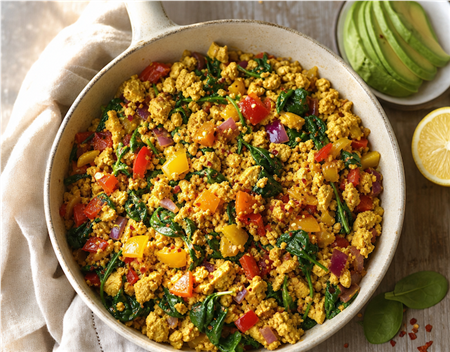
Savory Heart-Smart Scramble
Ready in under 10 minutes — because your mornings don't have time for complicated.
This one recipe, two paths approach means everyone at the table is covered — whether you're an egg eater or fully plant-based. Both versions deliver that 25 to 30 grams of protein your heart and metabolism are asking for first thing in the morning.
The Base — Shared by Both Versions
- 1 teaspoon olive oil
- 1/4 cup diced bell pepper (any color)
- 1/4 cup diced red onion
- 1 cup fresh baby spinach
- 1/4 teaspoon garlic powder
- 1/4 teaspoon black pepper
- Pinch of sea salt
- Optional: red pepper flakes for a little kick
The Fork in the Road
Egg Version
- 3 to 4 large eggs, whisked
- 1 tablespoon water (makes them fluffier)
- Optional: 1 oz crumbled feta or shredded cheese of choice
Plant-Based Version
- 1/2 block firm tofu, pressed and crumbled
- 1/4 teaspoon turmeric (for color and anti-inflammatory benefit)
- 2 tablespoons nutritional yeast (for savory depth and a boost of heart-supportive B vitamins)
- 1 teaspoon low-sodium soy sauce or coconut aminos
How To Make It
Heat olive oil in a non-stick skillet over medium heat.
Add bell pepper and onion and sauté for 2 to 3 minutes until softened.
Add spinach and cook for another minute until wilted.
For the egg version:
- Pour whisked eggs over the vegetables.
- Stir gently and cook until eggs are just set - about 2 to 3 minutes.
- Top with cheese if using and serve immediately.
For the plant-based version:
- Add crumbled tofu to the pan with the vegetables.
- Sprinkle in turmeric, nutritional yeast, soy sauce or coconut aminos, and remaining seasonings.
- Stir and cook for 3 to 4 minutes until heated through and golden.
- Serve immediately.
Serving suggestions
- Serve alongside a slice of whole grain or sprouted grain toast
- Wrap in a whole grain tortilla for a grab and go option
- Pair with a small piece of whole fruit for natural sweetness and fiber
- Add sliced avocado for healthy fat and extra staying power
Why This Works for Your Heart
- High quality protein supports muscle preservation and stable blood sugar.
- Spinach delivers magnesium for healthy heart rhythm
- Turmeric (plant-based version) is one of nature's most studied anti-inflammatory compounds
- Nutritional yeast provides B vitamins that support cardiovascular health
- Olive oil delivers heart healthy monounsaturated fat
No added sugar. No processed ingredients. No complicated steps. Simple food. Real ingredients. A heart that thanks you for it every single day.
 Suzie Jeffreys is an Exercise Physiologist, Certified Personal trainer, women's health coach, cardiac rehab specialist, and founder of Living Fitness Rx. With 30+ years in health and fitness, including 11+ years in elite cardiac rehab, she's the creator of the Holistic Heart Health Intensive and Your Comeback Season programs. Suzie helps women reclaim strength, energy, confidence, and vitality after heart scares, new diagnoses like high blood pressure or type 2 diabetes, and that stubborn feeling of being stuck in their bodies. She believes transformation doesn't come from quick fixes, instead it's about consistency, self-compassion, and habits that honor your life. Learn more at livingfitnessrx.com or set up a call with Suzie here: https://calendly.com/livingfitnessrx/hearttoheartstrategysession
Support Holistix Online
We're advancing awareness and access for holistic health and wellness. Your contributions help us continue in our mission to connect consumers with wellness providers, and build a community for both holistic professionals and wellness seekers.